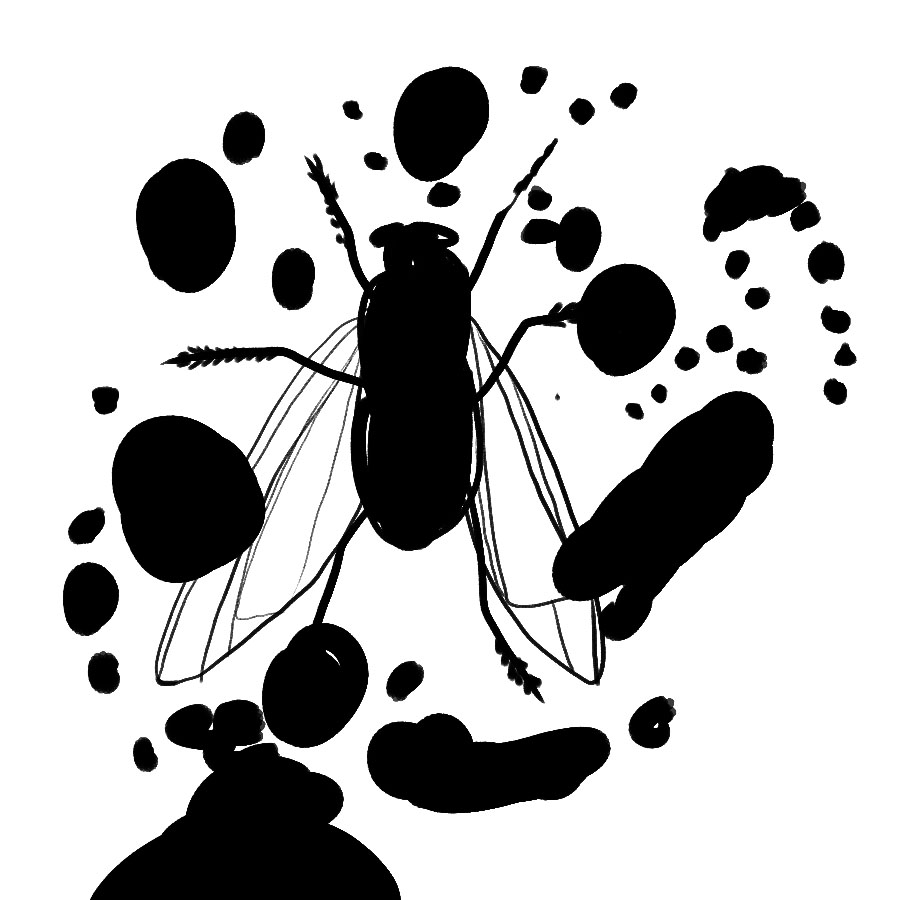
In looking for a good short story to read, I came across "The Fly," by Katherine Mansfield. The story demands the full attention of the reader, or they could ignore some key details. This was written in 1922, in the aftermath of WWI, and while the war itself is not front and center as a topic, its effects are clearly felt and feed into some central themes of the story. While I was reading, I kept wondering what the point was, and when I got to the end, I still didn't quite understand for a while. I had to go back, and when I did, I finally understood. Readers may see different meanings conveyed by this story, but it was poignant all the same for me.
In the short story, at one point a fly struggles for dear life while a man cruelly pours dollops of ink on it until it dies in agony. The man does not understand. It was so stubbornly holding on, and it kept getting back up again and again--why did it die after all that struggle? He casually throws it away bundled up in the paper it died upon, and does not seem to have learned anything from this experiment. He has gained a sudden amnesia as well, and forgotten his grief over his deceased soldier son, who may perhaps be likened to the fly in a sense. The same could be said for WWI, as the older generation threw away the lives of the young soldiers who died in the trenches and on foreign grounds for the sake of a dead Austro-Hungarian noble. They, as well, do not learn anything from this experiment in war, and so the cycle repeats itself in WWII.
Death is inevitable. Regardless of how wealthy or poor one is, whether one does a thousand good deeds or performs a thousand malignant evils, we all end up six feet under. I came away from this story that much more aware of my mortality, and maybe a bit more understanding of religion and why some people hang onto it for dear life. I am not religious, and when I read that there were churches refusing to abide to stay-at-home orders and opening for Easter celebrations, I couldn't help but simply shake my head in wonder and pity. But perhaps, for some, the idea of abandoning the last tenets of ordinary life is a graver threat than the coronavirus, and death is an imaginary specter until it comes knocking at their doors.
Will I lose the ability to grieve when the time comes that someone dear to me dies, years after the fact like the man in the story? I want to say that my tears will never stop when I reminisce, but perhaps my memories and the grief that comes with it will fade away after all. I don't know how to feel about that possibility. Will that make me less of a person? And I am that much more fearful of my inevitable death. I don't want to die struggling under the thumb of a cruel person like the fly did, and I certainly don't want to die a soldier fighting for a war devised on the chessboards of the older generation. I want to live a meaningful life. I don't want fame or fortune, or even love, though finding a understanding partner could certainly be beneficial. I suppose, what I mean to say, is that I want to be able to die with no regrets, content in my lot in life. I think that if I died now, or even a year later, I wouldn't be able to do so. When I will die is a factor I have no control over, and it hurts just a bit to know that I never will be able to. "The Fly" is a story about mortality in my eyes, and it has opened those eyes to the thinking that I must live life as if I am to die the very next day, for there is no certainty when it comes to death.

No comments:
Post a Comment